
Ecommerce Platform vs. Online Marketplace: Key Differences and How to Choose the Right Model (2026)
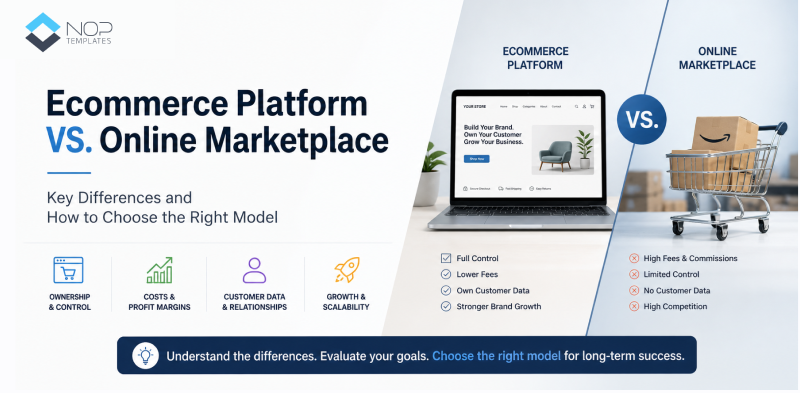
Table of Contents
- Platform vs. Marketplace: The Core Difference Explained
- How Big Is the Ecommerce Market and Where Is the Money?
- Amazon Fees, Etsy Fees, Shopify Costs: What You Really Pay
- Profit Margins: Platform vs. Marketplace by Product Category
- Why Selling on Marketplaces Costs You More Than the Commission
- When to Choose a Marketplace and When to Build Your Own Store
- The Multi-Channel Strategy That Is Driving 100%+ GMV Growth
- Shopify, WooCommerce, nopCommerce, Magento: Which Platform Fits?
- Key Ecommerce Trends Every Seller Needs to Know for 2026
- Five Questions That Will Tell You Exactly Which Model to Pick
- The Hidden Cost of Choosing the Wrong Model Too Late
- FAQ
You have a product and you are ready to sell. Then the question hits: do I build my own store, or do I just list on Amazon?
Most people search for an answer and find the same recycled pros and cons list everywhere. That does not help you decide. It just adds more noise.
This post cuts straight to it, real cost structures, actual margin data, and what is working for ecommerce businesses right now.
Platform vs. Marketplace: The Core Difference Explained
Both involve selling online, but they are fundamentally different models. Mixing them up is where most sellers make their first mistake.
Your Own Ecommerce Store
An ecommerce platform lets you build and run a store under your own domain. You control the design, the checkout, and every piece of customer data. The most widely used options are Shopify, WooCommerce, BigCommerce, nopCommerce, and Magento, each built for a different type of business, from fast-moving DTC brands to complex B2B operations.
Think of it as owning a retail location. You set the rules.
An Online Marketplace
A marketplace connects many sellers with buyers in one place. Amazon, eBay, Etsy, Walmart Marketplace, and TikTok Shop are the dominant players. You list inside their environment, they bring the buyers, and in exchange they take a commission on every sale and keep the customer relationship.
Think of it as renting a stall in a digital mall. The mall owns the foot traffic, the data, and the rules.
The core trade-off: Platforms give you ownership and control. Marketplaces give you reach and speed. The right choice depends on your stage and what you are building toward.
How Big Is the Ecommerce Market and Where Is the Money?
Online retail now makes up roughly 21% of all retail sales, and that share is still climbing. Amazon controls a dominant position in ecommerce, and during peak shopping periods the vast majority of American buyers shop there first.
On the platform side, Shopify's collective merchant volume has grown to nearly two-thirds of Amazon's third-party GMV, up from just 40% a few years ago. If every Shopify store were counted as one retailer, they would rank second only to Amazon.
The direct-to-consumer channel is not shrinking. It is maturing. Both models are growing, the question is which one grows your business.
About 15% of online shoppers now prefer buying directly from brands they trust, and that number has been rising for three straight years. Those buyers are already out there.
Amazon Fees, Etsy Fees, Shopify Costs: What You Really Pay
This is where most sellers get surprised. The real cost picture looks very different once you do the math at your actual sales volume.
Marketplace Costs
On Amazon, the base referral fee runs 9% to 15% per sale depending on category.The Professional seller plan adds $39.99 per month. FBA storage fees run about $0.78 per cubic foot off-peak and jump to $2.40 per cubic foot in Q4. Long-sitting inventory triggers additional charges on top.
Then there is advertising. Sponsored Ads routinely consume 20% to 33% of gross sales. As more brands enter Amazon, cost-per-click keeps rising. Most sellers underestimate this going in.
Other marketplace fees:
- Etsy: 6.5% per transaction plus $0.20 per listing
- eBay: Around 12.9% in final value fees
- Walmart Marketplace: 6% to 20% depending on category
One more thing sellers overlook: when a customer returns an item, some platforms refund only 80% of your selling fee. At scale, that adds up.
Platform Costs
Shopify starts at $39 per month. BigCommerce is comparable. nopCommerce is open-source and free at its core, with costs coming from hosting, development, and any extensions you add, a strong option for businesses wanting enterprise-level control without a recurring SaaS fee. WooCommerce works similarly on WordPress.
Payment processing typically runs 2.9% plus $0.30 per transaction. That is meaningfully lower than marketplace commissions at real sales volumes.
The structural difference worth remembering: subscription costs stay flat while your revenue grows. Marketplace commissions scale against you, every extra dollar in sales means more in fees.
| Ecommerce Platform | Online Marketplace | |
|---|---|---|
| Base cost | $29–$299+/mo | Free to list (some plans) |
| Per-sale cost | ~2.9% processing | 9–20%+ commission |
| Ad spend | You drive traffic | Often 20–33% of sales |
| As revenue grows | Cost % drops | Fee $ keeps climbing |
| Predictability | High | Variable |
High-performing ecommerce businesses keep total platform costs, subscriptions, processing, apps, at or below 15% of revenue. That is the number worth protecting as you scale.
Profit Margins: Platform vs. Marketplace by Product Category
After fees, ads, shipping, and returns, the margin difference between models becomes very real.
Sellers on their own stores typically net 10% to 20%, with top businesses hitting above 20%. Amazon sellers average 5% to 15% net, squeezed by fees, FBA costs, and rising ad spend.
By category:
- Beauty and personal care: 50–70% gross margin. One of the best categories for DTC, with strong repeat purchase rates
- Apparel and fashion: 12–18% net average, higher for brands with loyal buyers
- Home goods: Competitive on marketplaces; own-store brands win on curation and story
- Electronics: 8–12% net. Accessories and peripherals beat core devices on margin
- Handmade and artisan: Strong discovery on Etsy, but own-store margins tend to be better once you have an audience
Amazon seller margins have been under real pressure recently. Rising ad CPCs, higher FBA fees, and more competition have squeezed profitability across many categories. Sellers making it work are focused on conversion rate optimization. A 1% to 2% lift in conversion can restore the margin that more ad spend simply cannot.
Why Selling on Marketplaces Costs You More Than the Commission
On your own store, every purchase gives you the customer's email, purchase history, and behavioral data. You can re-target, build email sequences, run loyalty programs, and understand exactly who buys from you and why.
Email marketing returns an average of $36 for every $1 spent, the highest-ROI channel in ecommerce. That channel only exists if you own the customer relationship.
On any marketplace, the platform owns all of that. You get the order. They get the customer. You cannot email marketplace buyers directly. You cannot re-target last month's purchasers. If the algorithm changes or your listing gets suppressed, you have nothing to fall back on.
At low volumes this feels like a theory. At $500K to $1M in annual revenue, it becomes an expensive reality.
Many strong brands use marketplace sales as the top of the funnel and then bring customers into their own ecosystem through packaging inserts, post-purchase sequences, and content. That works, but only if you have your own platform to bring them into.
When to Choose a Marketplace and When to Build Your Own Store
A marketplace makes sense when you:
- Are testing whether a product has real demand before building a brand around it
- Need immediate revenue without an existing audience or ad budget
- Sell in categories where buyers start on Amazon : electronics, books, household basics
- Want fulfillment handled without building your own logistics operation
- Are operating seasonally or part-time with low fixed overhead
Your own platform makes sense when you:
- Are building a brand with a story and customers you want to retain long-term
- Sell products that need context, visuals, or education to convert, things a listing cannot communicate
- Are in a repeat-purchase category like beauty, supplements, food, or apparel
- Are ready to invest in SEO, email, and content that build compounding value
- Want to run loyalty programs, subscriptions, or custom pricing on your terms
- Are building a business asset rather than a revenue stream tied to another platform's rules
The Multi-Channel Strategy That Is Driving 100%+ GMV Growth
Brands selling across three or more channels see an average 104% increase in GMV. Adding one new sales channel drives an average 38% revenue increase. Three channels can produce up to 190% growth. Single-platform dependency is not just a risk, it is a ceiling.
The approach that works is using both models deliberately:
- Start on a marketplace to validate demand, generate early reviews, and create cash flow without a traffic budget
- Launch your own store once the product is proven and make building an email list the first priority
- Keep the marketplace listing active for ongoing discovery, treat the commission as a customer acquisition cost
- Invest in SEO and email on your own platform, because these compound over time while paid visibility stops the moment you stop paying
Brands that start on Etsy and migrate to their own store while keeping the Etsy listing running consistently report that the migration is what made sustainable growth possible. The marketplace drove discovery. The owned store built the brand.
Shopify, WooCommerce, nopCommerce, Magento: Which Platform Fits?
Most serious ecommerce businesses eventually build their own store. When that time comes, the platform choice matters more than most people expect. The wrong foundation means technical debt and a painful rebuild later.
The main options and who they suit:
- Shopify: Leads the U.S. market at around 30% share. Fast to set up, strong app ecosystem, great for brands wanting speed without heavy technical work
- WooCommerce: Runs on WordPress, leads globally by install count. Flexible and open-source, ideal if you already have WordPress infrastructure or need strong SEO and content integration
- nopCommerce: Open-source .NET platform built for serious customization. Well-suited for complex catalogs, B2B features, multi-store setups, and businesses that want full tech stack control without SaaS lock-in. Free at its core with a mature plugin and theme ecosystem
- BigCommerce: Built for mid-market and enterprise. Strong native B2B and omnichannel features for teams needing power without full custom development
- Magento / Adobe Commerce: The enterprise choice. Deeply powerful and fully customizable, but requires significant development resources and ongoing maintenance
The right platform is not the one with the most features. It is the one that fits your team's technical capacity, your catalog's complexity, and the flexibility you will need as you scale.
Key Ecommerce Trends Every Seller Needs to Know for 2026
Social commerce is a real channel now. TikTok Shop has seen explosive growth with hundreds of millions engaging in in-app shopping. For brands targeting buyers under 35, it is a primary discovery channel today.
AI is reshaping product discovery. Amazon's AI assistant Rufus drove significant incremental sales in its first full year. Sellers optimizing listings for conversational, intent-based search are gaining an edge that compounds going forward.
Price competition has intensified. Temu reached $22 billion in U.S. GMV in a remarkably short time. In price-driven categories, competing on cost against supply chain arbitrage platforms is extremely hard. Competing on brand and experience is not.
Niche marketplaces are growing fast. Etsy serves nearly 95 million active buyers. Whatnot hit $6 billion through live auctions. Wayfair leads home goods at $10 billion. "Amazon or nothing" is no longer true for most categories.
Mobile is the default. Nearly 60% of online retail transactions happen on mobile. If your checkout creates friction on a phone, you are losing sales that never appear in your reports.
Five Questions That Will Tell You Exactly Which Model to Pick
The confusion usually comes from comparing the wrong things, marketplace traffic against a new store's zero traffic, or commission percentages against subscription costs without factoring in ad spend and customer lifetime value.
Ask yourself:
- Do I have a proven product or am I still testing? Marketplaces let you validate with zero traffic cost. Build your own store once demand is confirmed.
- Is there a brand story worth telling? If yes, a marketplace listing will always undersell it. Your own store lets you tell it fully.
- Does my category reward search intent or brand loyalty? Commodity products win on marketplaces. Repeat-purchase, brand-loyal products win on owned platforms.
- What does my plan two to three years out require? Building something serious means owning your customer list. Marketplace-only is a ceiling.
- Do I have a traffic plan? No plan yet, start on a marketplace. Have an SEO and content roadmap, build your own store and start compounding now.
The Hidden Cost of Choosing the Wrong Model Too Late
Stay marketplace-only and eventually you hit a wall. No customer list. No brand equity outside the platform. No leverage when fees rise and they always do.
Launch your own store too early without a traffic plan and you build something nobody visits.
The businesses getting this right are thinking clearly about both: what they need to generate revenue today and what they need to own long-term. They are not defaulting to the easiest option. They are building deliberately.
The customer data you do not collect, the brand you do not build, the margin you give away while figuring things out, these costs are real and they compound quietly.
Start with clarity. Build accordingly.
What is your current setup, marketplace only, own store, or both?
Drop a comment. If this was useful, share it with someone working through this decision right now.
FAQ
Q: Is it better to sell on Amazon or have my own website?
It depends on your stage. Marketplaces offer immediate reach and traffic. Your own store gives you brand control, customer data, and better long-term margins. Most successful sellers use both, marketplace for discovery, owned store for retention.
Q: What are the fees for selling on Amazon vs. running a Shopify store?
Amazon charges 9–15% referral fees plus $39.99 per month for the Professional plan, plus FBA and advertising costs. Shopify starts at $39 per month plus roughly 2.9% payment processing. At meaningful sales volume, platform costs are typically lower as a percentage of revenue.
Q: Can I sell on Amazon and have my own ecommerce store at the same time?
Yes, and most serious sellers do exactly this. Use the marketplace for discovery and initial sales. Use the owned store for brand-building, customer data, email marketing, and long-term margin.
Q: What is nopCommerce and who is it for?
nopCommerce is a free, open-source ecommerce platform built on .NET. It suits businesses needing enterprise-level customization, complex catalog management, B2B features, or multi-store functionality without ongoing SaaS fees.