
eCommerce Branding Strategy for 2026: How Successful Online Brands Win
Introduction
In eCommerce, your brand is often judged before a customer reads a single product detail. Within seconds of landing on your website, visitors decide whether your business feels trustworthy, professional, and worth exploring.
In markets filled with similar products and competing stores, brand perception becomes the deciding factor.
The stores that grow are not just selling items, they are building recognizable, consistent experiences that customers remember and return to.
Effective online store branding ensures that every touch-point, from ads to checkout, feels consistent and reinforces what your business stands for.
Branding is the reason someone chooses your store over hundreds of others.
It lives in 3 places:
- Customer's mind – what they believe about you
- Customer's emotions – how they feel about buying from you
- Customer's memory – whether they remember you next time
Research shows that 33% of businesses report revenue growth from brand consistency, and 59% of shoppers prefer buying from brands they already recognize.
Why Branding Matters More in Modern eCommerce
In 2026, eCommerce advertising costs continue to rise each year as competition intensifies, forcing many online stores to spend 10 to 20% of their monthly revenue just to stay visible.
Marketplaces such as Amazon now control a large share of the US market, while hundreds of new sellers join daily, increasing the fight for attention.
At the same time, AI has made product creation faster and easier, leading to an explosion of similar products and making true brand differentiation more important than ever.
| Without Strong Brand | With Strong Brand |
|---|---|
| Compete on price | Compete on value |
| One-time buyers | Repeat buyers |
| High ad cost | Lower CAC over time |
| Forgettable | Memorable |
| Transaction-focused | Relationship-driven |
Understanding why branding matters is only the first step. The next question is how successful eCommerce brands build it in practice.
The Process Behind Strong eCommerce Branding
Step 1: Define Your Positioning
Ask:
- Who are we for? (Not "everyone")
- What problem do we solve better than others?
- What do we want customers to say about us?
Example: "Affordable luxury skincare for busy working women who don't have time for 10-step routines."
That single line guides:
- Product range
- Packaging
- Ads
- Messaging
- Tone
Without this, your marketing feels random. To build a strong ecommerce brand, businesses must align positioning, visuals, messaging, and customer experience under one clear and memorable identity.
Step 2: Define Your Brand Personality
If your brand was a person, would it be:
- Expert and clinical?
- Friendly and helpful?
- Bold and trendy?
- Premium and minimalist?
Consistency here increases trust.
Trust leads to higher conversion rates.
Step 3: Align the Customer Journey
Branding is experienced at every stage:
| Stage | Branding Happens Through |
|---|---|
| Ad | Visuals and promise |
| Product page | Tone, proof, clarity |
| Checkout | Trust signals |
| Packaging | Unboxing emotion |
| Emails | Relationship tone |
| Support | Problem resolution style |
If your ads say "premium" but your packaging feels cheap → brand breaks → trust drops → repeat rate drops.
Step 4: Build Emotional Hooks
People don't remember specifications. They remember feelings.
You need at least one:
- Lifestyle aspiration
- Community belonging
- Problem relief
- Identity expression
Example:
- Fitness brand = "You're becoming your best self"
- Eco brand = "You're helping the planet"
- Tech gadget = "You're smarter and ahead"
Emotion creates memory. Memory drives repeat purchases.
What is Included in eCommerce Branding
Most businesses focus on logo and colors. But that is just a small part of branding. Complete eCommerce branding covers much more and shapes how customers recognize, trust, and remember your store.
Core Strategy
Positioning, target persona, and unique value perception define who your brand is for and why customers should choose you over competitors.
Visual Identity
Logo, color psychology, typography, and product photography style create visual consistency and help customers instantly recognize your brand.
Voice and Messaging
Taglines, website tone, ad copy tone, and email personality shape how your brand sounds and communicates with customers.
Experience Branding
Packaging feel, delivery experience, the unboxing moment, and customer support style influence how customers feel after they buy from you.
Trust Branding
Reviews, social proof, founder story, and transparency build credibility and reduce hesitation before purchase.
Theme and Layout Impact
Your store's theme is part of branding too. Layout, spacing, speed, and structure shape first impressions, perceived product quality, and shopping comfort. A well-aligned theme strengthens trust and recognition, while a poor one weakens brand credibility before a customer even reads your content.
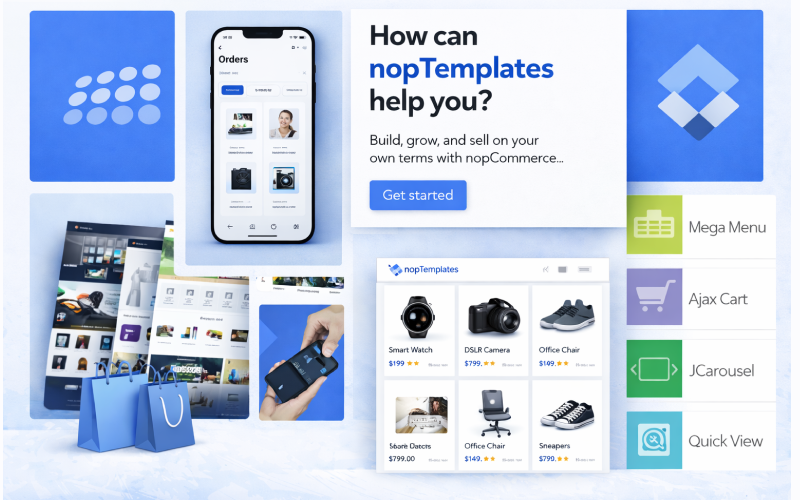
Because design affects brand perception, choosing a theme built with branding in mind matters. nopTemplates offers nopCommerce themes created to support strong brand presentation and user experience.
How Strong Branding Helps You Sell More and Spend Less
- Higher conversions – Recognizable brands reduce hesitation, often lifting conversion rates by 20–30%
- Premium pricing power – Strong brands can support 20–50% higher prices because customers buy perceived value, not just product specs
- Lower cart abandonment – Consistent messaging across ads and product pages can reduce drop-offs by 15–25%
- Bigger orders – Emotional connection and brand trust increase AOV through bundles and upgrades
- Cheaper repeat revenue – Returning customers cost up to 5x less than acquiring new buyers
- More efficient advertising – Brand familiarity improves ad engagement, lowering CPM and long-term CAC
The Big Strategic Shift for 2026
The old eCommerce model was simple: run ads, sell products, and repeat. Growth depended on constantly feeding paid traffic.
In 2026, the model has shifted. Brands that win build trust first, reduce acquisition pressure over time, and grow through repeat customers. The new path is clear: build brand, earn trust, lower CAC, and increase lifetime value.
Conclusion
If you want to upgrade your branding, start with one clear positioning statement. Make sure your website, ads, packaging, and communication all reflect it consistently.
Define one emotional promise your customers can connect with, then use automation and AI tools to keep execution consistent as you scale.
Track branding through real business signals: repeat purchase rate, growth in direct traffic, branded search, and average order value.
Branding is not an expense. It is a profit multiplier that reduces ad dependency and increases long-term customer value.