
Best B2B Ecommerce Platform for Fashion Wholesale Brands in 2026: nopCommerce vs Shopify vs WooCommerce
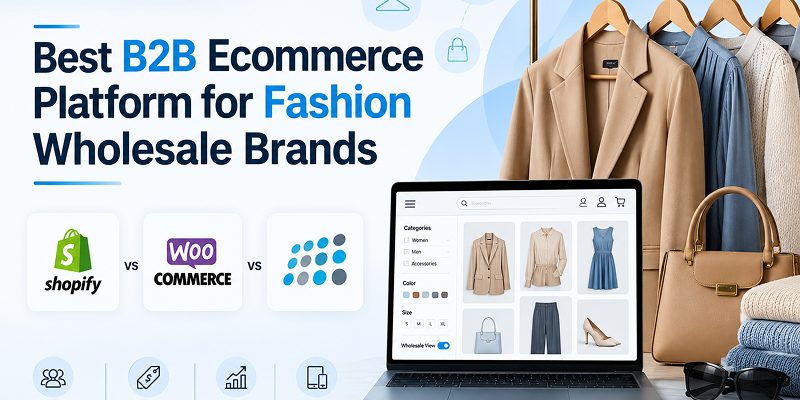
Table of Contents
- Introduction
- What Makes Fashion B2B Ecommerce Complex
- Evaluation Criteria for a Fashion B2B Platform
- nopCommerce for Fashion B2B
- Shopify for Fashion B2B
- WooCommerce for Fashion B2B
- Side-by-Side Comparison
- Best Platform by Fashion Business Scenario
- Why Platform Choice Affects Conversion and Revenue
- Final Recommendation
- FAQ
- Get Started
Introduction
Choosing the right platform for a fashion wholesale business isn't the same as choosing one for a typical online store. Fashion B2B requires customer-specific pricing, company accounts, bulk ordering, and catalogs tailored to different buyers.
This guide compares nopCommerce, Shopify, and WooCommerce for fashion B2B ecommerce using current market data, helping you choose the platform that best fits your business.
Fashion is also a visual industry. Buyers expect a professional buying experience alongside the operational features wholesale demands.
The timing matters. The global B2B ecommerce market is projected to reach $28.03 trillion in 2026, while the fashion B2B market is expected to reach $14.47 billion and continue growing rapidly. Choosing the right platform today can make scaling easier tomorrow.
This comparison examines where nopCommerce, Shopify, and WooCommerce perform best and which type of fashion wholesale business each platform suits.
What Makes Fashion B2B Ecommerce Complex
Fashion wholesale has requirements that go far beyond a standard ecommerce store. These aren't edge cases, they're standard requirements for many fashion wholesale businesses. The key question is whether your platform supports them natively or relies on workarounds.
- Seasonal collections with pre-orders and pre-booking
- Customer-specific pricing and negotiated terms
- Fast bulk ordering and reordering
- Large size and color variant catalogs
- Different rules for boutiques, distributors, and resellers
- Customer-specific catalog visibility
- Multi-store or multi-brand management
- ERP, CRM, and inventory integration
Evaluation Criteria for a Fashion B2B Platform
When you strip away marketing language, a fashion B2B platform really needs to be judged on nine things:
- Account and role management — company accounts, buyer roles, and approval hierarchies
- Pricing flexibility — tiered, contract, and customer-specific pricing without manual workarounds
- Catalog and collection control — showing the right products to the right accounts
- RFQ and approval support — quote requests, negotiation, and order approval flows
- Variant handling — clean management of size, color, and style variants at scale
- Integration flexibility — ERP, CRM, PIM, and fulfillment connections
- Scalability — performance as SKU count, order volume, and account count grow
- Maintenance effort — ongoing technical upkeep versus set-and-run simplicity
- Design and merchandising flexibility — how much creative control you have over the buying experience
Every platform below is measured against these nine points, not generic feature lists.
nopCommerce for Fashion B2B: Full Control for Complex Wholesale Operations
nopCommerce is an open-source, self-hosted platform built on .NET. Its biggest strength is flexibility — it gives businesses full control over complex B2B workflows.
Where It Excels
- Customer-specific pricing based on customer, role, or quantity
- Role-based catalogs and collection visibility
- Flexible company account management
- Custom RFQ and quote-to-order workflows
- Extensive customization for variant-heavy catalogs, checkout rules, and wholesale processes
The tradeoff is technical ownership. Hosting, updates, security, and development are your responsibility, either internally or through a development partner. In return, you gain a platform without the customization limits common to hosted solutions.
Best Suited For Fashion wholesale businesses with
- Multiple customer groups
- Complex pricing structures
- ERP or third-party integrations
- Multi-brand or multi-region operations,
- Custom wholesale workflows
If your wholesale business is outgrowing workarounds, nopCommerce is built for that level of complexity.
Shopify for Fashion B2B: Speed and Simplicity
Shopify is a hosted platform designed for fast deployment and low maintenance. Its native B2B features support customer-specific pricing, quantity rules, and payment terms, making it a solid choice for straightforward wholesale operations.
Where It Excels
- Fast implementation with minimal infrastructure
- Fully hosted with automatic maintenance and security updates
- Large app ecosystem for extending functionality
- Supports both DTC and wholesale from a single store
The Tradeoff
As wholesale workflows become more complex, businesses often rely on additional apps or custom development for advanced catalog visibility, quote-to-order processes, and ERP integrations. Many advanced B2B capabilities also require Shopify Plus.
Best Suited For
Fashion brands that want a quick launch, low maintenance, and standard B2B functionality without extensive customization.
WooCommerce for Fashion B2B: WordPress Flexibility
WooCommerce extends WordPress into an ecommerce platform, making it a practical choice for businesses already invested in the WordPress ecosystem.
Where It Excels
- Integrates seamlessly with existing WordPress websites
- Supports wholesale features through established plugins
- Low upfront cost with flexible hosting options
- Large developer community and ecosystem
The Tradeoff
Wholesale functionality depends heavily on plugins. As the number of extensions, products, and orders grows, maintenance, compatibility, and performance can become ongoing challenges.
Best Suited For
WordPress-based fashion businesses with moderate wholesale requirements and smaller catalogs that want to stay within the WordPress ecosystem.
nopCommerce vs Shopify vs WooCommerce: Side-by-Side Comparison
| Criteria | nopCommerce | Shopify | WooCommerce |
|---|---|---|---|
| Best for | Medium to enterprise fashion wholesale businesses | Small to mid-sized brands that want to launch quickly | WordPress-based businesses with moderate B2B needs |
| Deployment | Self-hosted | Fully hosted (SaaS) | Self-hosted |
| Initial Cost | Higher (development and setup) | Lower | Low |
| Long-Term Cost | Predictable; no platform transaction fees | Can increase with Shopify Plus, apps, and transaction fees | Plugin, maintenance, and hosting costs grow over time |
| Development Requirement | Medium to High | Low to Medium | Medium |
| Customization | Unlimited (open source) | Limited by platform and apps | High, but plugin-dependent |
| B2B Pricing | Native customer, role, and tier pricing | Good native support; advanced cases may require Shopify Plus | Usually handled through plugins |
| Catalog Visibility | Advanced role-based control | Good for standard B2B | Plugin-dependent |
| Variant Management | Excellent for large fashion catalogs | Strong | Good for moderate catalogs |
| ERP/CRM Integration | Excellent | Good | Good |
| Performance at Scale | Excellent | Excellent | Depends on hosting and plugin quality |
| Maintenance | Managed by your team or development partner | Shopify handles maintenance | Ongoing WordPress and plugin maintenance |
| Scalability | Built for complex B2B growth | Excellent for growing brands | Suitable for moderate growth |
| Implementation Speed | Slower | Fastest | Fast if WordPress is already in place |
| Future Flexibility | No platform limitations on customization | Limited by Shopify's ecosystem | Can become harder to manage as plugin count grows |
| Ideal Business Stage | Established or rapidly growing wholesale businesses | Businesses validating or scaling wholesale quickly | Existing WordPress businesses expanding into wholesale |
Best Platform by Fashion Business Scenario
| Business Scenario | Recommended Platform | Why |
|---|---|---|
| Boutique Wholesale Brand | Shopify (or WooCommerce if on WordPress) | Quick launch with straightforward wholesale pricing |
| Growing DTC + Wholesale Brand | Shopify → nopCommerce | Start with Shopify; move to nopCommerce when pricing, catalogs, or ERP become complex |
| Multi-Brand or Multi-Region Business | nopCommerce | Handles multiple brands, regions, currencies, and complex account structures natively |
| WordPress-Based Business | WooCommerce | Practical extension of an existing WordPress site for moderate wholesale requirements |
| Enterprise Fashion Distributor | nopCommerce | Handles large catalogs, negotiated pricing, ERP integration, and complex wholesale workflows |
Why Platform Choice Affects Conversion and Revenue
Your ecommerce platform influences more than operations — it directly impacts sales. If wholesale buyers can't see negotiated pricing, reorder quickly, or access the right catalogs, purchasing becomes slower and more frustrating. Every extra step increases the risk of losing the order.
Research reports that 83% of B2B buyers prefer self-service purchasing, and nearly two-thirds abandon purchases when their preferred payment terms aren't available. Mobile is equally important, with 80% of buyers using it to research products or place orders.
The easier your platform makes pricing, ordering, and reordering, the more likely buyers are to complete their purchases and return.
Final Recommendation
If your fashion wholesale operation involves multiple account tiers, custom pricing, ERP integration, or multi-brand management, nopCommerce is the strongest long-term choice. It removes the customization ceiling, making it well suited for wholesale businesses that continue to grow.
If you need to launch quickly with a lighter B2B workload and minimal technical maintenance, Shopify is a smart choice, especially for hybrid DTC and wholesale brands.
If you already run on WordPress and your wholesale requirements are moderate, WooCommerce lets you extend your existing ecosystem without a platform migration.
A practical rule: if you can describe your wholesale pricing and account structure in one sentence, Shopify or WooCommerce will likely meet your needs. If it takes a whiteboard to explain your pricing tiers, approval flows, and catalog rules, you need nopCommerce.
FAQ
Which platform is best for fashion B2B ecommerce in 2026?
For complex wholesale logic, customer-specific pricing, and long-term scalability, nopCommerce is the strongest fit. Shopify suits brands that want speed and simplicity, and WooCommerce suits WordPress-based businesses with moderate complexity.
Can Shopify handle fashion wholesale catalogs?
Yes, Shopify's native B2B features support customer-specific pricing, quantity rules, and payment terms. It works well for straightforward wholesale workflows but can hit limits with highly customized quote-to-order or catalog visibility needs.
Is WooCommerce good enough for a wholesale fashion store?
WooCommerce works well for moderate complexity, especially for brands already using WordPress. Heavier reliance on stacked plugins can create maintenance and performance tradeoffs as catalog size and order volume grow.
Why is nopCommerce recommended for complex fashion B2B operations?
Because it is open source and self-hosted, nopCommerce has no built-in ceiling on customization. Customer-specific pricing, corporate account structures, and quote-to-order flows can all be built natively rather than layered on with apps.
What is quote-to-order and why does it matter for fashion wholesale?
Quote-to-order is the process of a buyer requesting pricing or terms, negotiating, and converting that quote into a confirmed order. It matters because many fashion wholesale relationships are negotiated, not fixed-price, and the platform needs to support that flow without manual, off-platform steps.
Get Started with nopCommerce
If you're building or migrating a fashion wholesale store on nopCommerce, browse nopTemplates' collection of themes and plugins built for fashion wholesale stores, variant-rich catalogs, and better buying experiences.
No pressure, just a good starting point if nopCommerce is the direction you're leaning.