
AI-Powered Upselling and Cross-Selling: What These Strategies Actually Mean After the AI Revolution
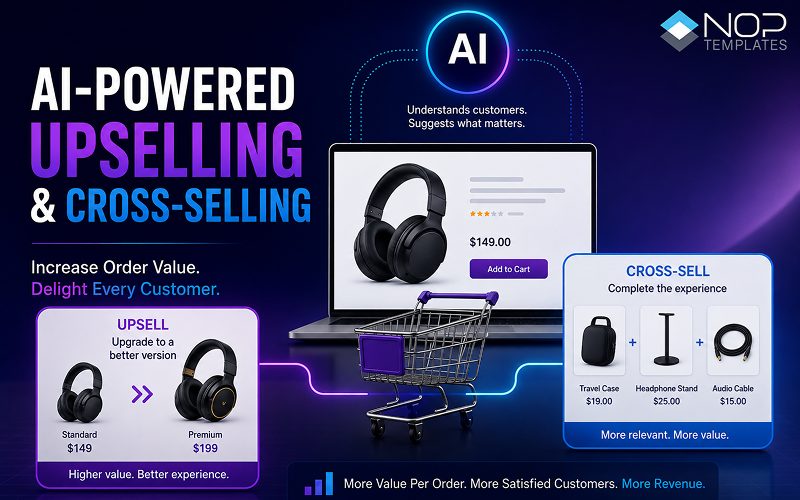
Table of Contents
- Introduction
- What Upselling Actually Means After the AI Revolution
- What Cross-Selling Actually Means After the AI Revolution
- How AI Actually Decides What to Recommend
- Why Traditional Product Recommendations No Longer Work
- Five Modern Upselling and Cross-Selling Strategies Leading Brands Use Today
- Real-World Upselling Examples
- Real-World Cross-Selling Examples
- Why Most eCommerce Stores Still Get Upselling and Cross-Selling Wrong
- The Business Impact: What Results Can Brands Realistically Expect?
- The New eCommerce Rule for 2026
- Key Takeaways
- Conclusion
- FAQ
Introduction
For years, eCommerce growth followed a familiar formula: drive more traffic, acquire more customers, and generate more sales.
That approach still works, but it is becoming increasingly expensive. Customer acquisition costs continue to rise across most digital channels, forcing brands to look beyond traffic generation and focus on maximizing the value of every visitor who already arrives at their store.
As a result, many eCommerce leaders are asking a different question:
How can we generate more revenue from the traffic we already have?
This is where upselling and cross-selling have become more important than ever.
Traditionally, these strategies were relatively simple. If a customer viewed a laptop, the store displayed a mouse. If someone added running shoes to their cart, they saw socks. If a customer purchased a smartphone, they were shown a phone case.
The logic worked, but it lacked context.
A first-time visitor and a loyal customer often received the same recommendations despite having completely different interests, budgets, and buying goals.
Artificial intelligence has changed that.
Modern recommendation engines no longer rely solely on predefined product relationships. Instead, they analyze browsing behavior, purchase history, session activity, product affinity, and thousands of behavioral signals to understand what a customer is most likely to need next.
The result is not simply more recommendations, but more relevant recommendations.
And that shift has fundamentally changed what upselling and cross-selling mean in modern eCommerce.
What Upselling Actually Means After the AI Revolution
Most people still define upselling as encouraging customers to purchase a more expensive version of a product.
But in modern eCommerce, that definition is incomplete.
Traditional upselling focused primarily on increasing transaction value. If a customer viewed a $499 product, the store often recommended the $699 version regardless of whether the upgrade was relevant.
The assumption was simple:
Higher price equals better upsell opportunity.
Unfortunately, customers do not shop that way.
A shopper is rarely searching for the most expensive option. They are searching for the option that best solves their problem.
Modern AI-powered upselling changes the conversation.
Instead of asking,
"What is the most expensive product we can show?"
AI ask:
"Which product is this customer most likely to find valuable?"
A traditional upsell might simply recommend the most expensive chair in the catalog. An AI-powered recommendation engine takes a different approach. If the customer repeatedly compares lumbar support features, reads comfort-focused reviews, and spends time evaluating premium workspace products, the system may recommend a chair with advanced ergonomic support rather than simply the highest-priced option.
That is the biggest difference between traditional and AI-powered upselling. The objective is no longer to convince customers to spend more. The objective is to help them make a better buying decision while naturally increasing order value.
What Cross-Selling Actually Means After the AI Revolution
Traditional cross-selling was relatively straightforward. If a customer bought a camera, the store recommended a memory card. If they purchased a laptop, they saw a laptop bag. The recommendations were related, but they were often identical for every customer.
Modern AI-powered cross-selling takes a different approach.
Instead of asking, "What products are commonly purchased together?"
AI asks: "What is this customer trying to achieve?"
Imagine two customers purchasing the same camera.
Customer A spends time comparing professional lenses, reviewing camera bodies, and researching lighting equipment.
Customer B browses travel accessories, compact gear, and battery life specifications.
The recommendation engine identifies these behavioral patterns and adapts accordingly.
Customer A may receive recommendations for professional lenses, studio lighting, and high-capacity storage solutions.
Customer B may see travel bags, extra batteries, and compact tripods.
The recommendations are shaped by how the customer is most likely to use the product. This is why modern cross-selling feels less like a sales tactic and more like personalized shopping assistance.
How AI Actually Decides What to Recommend
A common misconception is that AI somehow "knows" what customers want.
In reality, AI is making predictions.
Every click, search, comparison, and purchase creates signals that help recommendation engines understand customer behavior.
Modern AI recommendation systems typically rely on four major data sources.
| Data Source | What It Reveals |
|---|---|
| Behavioral Data | This includes products viewed, searches performed, time spent on pages, product comparisons, wishlist activity, and add-to-cart actions. These signals help AI understand what a customer is interested in right now. |
| Purchase History | Previous purchases reveal buying preferences, spending habits, and category interests. Customers who consistently purchase premium products often respond differently than first-time buyers. |
| Product Affinity | AI analyzes purchasing patterns across thousands of transactions to identify which products naturally belong together. For example, customers who purchase gaming consoles often buy controllers and storage expansions. |
| Similar Customer Patterns | If customers who exhibit similar browsing patterns frequently purchase a specific product next, the system can predict and recommend that product to future shoppers displaying the same behavior. |
Rather than reacting to purchases, AI increasingly anticipates customer needs. This predictive capability is one reason AI-powered recommendations consistently outperform traditional rule-based approaches. McKinsey research suggests AI-driven analytics can improve recommendation and expansion conversion rates by 20-25%.
Why Traditional Product Recommendations No Longer Work
Traditional recommendation systems were built on static rules. For example:
- If Product A is purchased, show Product B.
- If a customer views Product X, recommend Product Y.
This approach becomes difficult to scale as product catalogs grow. A retailer with thousands of products cannot realistically maintain meaningful relationships between every product manually.
Static rules also lack context. They cannot distinguish between a new customer and a loyal customer. They cannot identify changing trends. They cannot learn from customer behavior.
AI-powered recommendation systems solve these challenges by continuously adapting to customer interactions. Instead of relying on assumptions, they learn from real behavior.
Five Modern Upselling and Cross-Selling Strategies Leading Brands Use Today
1. Hyper-Personalized Recommendations
Modern recommendation engines personalize suggestions based on browsing activity, purchase history, cart contents, and customer preferences. Two customers viewing the same product may receive completely different recommendations.
2. Progressive Bundling
Instead of recommending individual products, AI can create intelligent bundles that help customers achieve a specific goal. For example, a home office bundle may include a desk, chair, monitor arm, and accessories.
3. Tiered Pricing and Smart Upgrades
AI helps businesses present upgrades based on customer needs rather than simply promoting the most expensive option. This improves both relevance and conversion rates.
4. Post-Purchase Upselling
Some of the best upsell opportunities occur after the original purchase. At this stage, trust has already been established and purchasing friction is lower. Examples include accessories, warranties, subscriptions, and service upgrades.
5. Frictionless Recommendations
Timing matters. Upgrade recommendations often perform best on product pages. Complementary products frequently convert best in carts, checkout flows, and post-purchase experiences. While the recommendation itself matters, timing often determines success.
Real-World Upselling Examples
Consumer Electronics
A customer researching laptops repeatedly compares processor performance, storage options, and memory configurations. Instead of promoting the highest-priced model, AI recommends a configuration that better aligns with the customer's performance requirements.
Home Furniture
A shopper exploring family-sized sofas repeatedly views durable materials and larger seating arrangements. The recommendation engine may suggest premium fabric upgrades or larger configurations that better match household needs.
Beauty and Skincare
A customer purchasing a moisturizer may receive recommendations for a complete skincare routine because customers with similar concerns frequently achieve better results using complementary products.
In each case, the recommendation supports a customer goal rather than simply increasing price.
Real-World Cross-Selling Examples
Fashion Retail
A customer purchasing running shoes may receive recommendations for hydration belts, performance socks, and fitness tracking accessories because the system recognizes broader fitness-related shopping behavior.
Consumer Electronics
A gaming console buyer may receive recommendations for controllers, headsets, subscription services, or storage upgrades based on browsing activity and customer segment data.
Subscription and Replenishment Commerce
A customer purchasing supplements may later receive replenishment reminders, subscription options, or complementary wellness products based on expected usage patterns.
These recommendations support the customer's journey rather than simply promoting additional products.
Why Most eCommerce Stores Still Get Upselling and Cross-Selling Wrong
Many businesses assume recommendation technology alone will solve the problem. In reality, strategy matters just as much.
Common mistakes include:
- Treating every customer the same
- Prioritizing revenue over customer value
- Showing too many recommendations
- Ignoring timing
- Relying on static product relationships
- Measuring clicks instead of business outcomes
The most successful brands view upselling and cross-selling as customer experience strategies rather than sales tactics. Their goal is to help customers discover products that genuinely improve their purchase outcomes.
The Business Impact: What Results Can Brands Realistically Expect?
When implemented effectively, AI-powered recommendations can influence several important business metrics. According to Bain & Company, mature upsell and cross-sell programs can generate 25-30% more revenue per customer.
| Metric | What It Measures |
|---|---|
| Average Order Value (AOV) | A store generating 1,000 orders per month with a $100 average order value produces $100,000 in monthly revenue. A 20% increase in AOV increases revenue to $120,000 without acquiring additional traffic. |
| Attach Rate | Attach rate measures how often customers purchase secondary products alongside their primary purchase. Higher attach rates often indicate stronger cross-selling performance. |
| Customer Lifetime Value (CLV) | Recommendations do not only impact the first purchase. They influence repeat purchases, subscriptions, replenishment orders, and long-term customer relationships. |
| Revenue Per Visitor | As customer acquisition costs continue to increase, many brands focus on maximizing revenue from existing visitors rather than simply generating more traffic. |
The New eCommerce Rule for 2026
For years, upselling and cross-selling were treated as sales tactics. Today, they are increasingly becoming customer experience strategies.
The goal is no longer: "How do we sell more products?"
The goal is: "How do we help customers make better purchasing decisions?"
More relevant recommendations drive stronger engagement, which often leads to higher revenue.
The old approach was: show more products.
The modern approach is: show the right product, at the right moment, to the right customer, for the right reason.
Key Takeaways
- AI has transformed upselling and cross-selling from rule-based tactics into data-driven recommendation strategies
- Modern recommendation engines focus on customer goals rather than product relationships alone
- AI uses behavioral data, purchase history, product affinity, and customer patterns to personalize recommendations
- Successful upselling focuses on value rather than price
- Successful cross-selling helps customers achieve better outcomes
- Recommendation timing is often as important as the recommendation itself
- Businesses should measure AOV, Attach Rate, Revenue Per Visitor, and CLV to evaluate performance
Conclusion
AI did not reinvent upselling and cross-selling. It reinvented how businesses understand customers.
Modern recommendation engines use behavior, context, and shopping patterns to deliver recommendations that feel helpful rather than intrusive.
As a result, upselling is no longer about convincing customers to spend more, and cross-selling is no longer about adding random products to a cart.
The future of upselling and cross-selling is not about selling more. It is about helping customers buy better.
Every store faces unique challenges when it comes to upselling and cross-selling.
What is the biggest challenge you currently face with upselling and cross-selling, and where do you think AI could make the biggest impact?
We'd love to hear your thoughts, experiences, and ideas in the comments below.
FAQ
How is AI-powered upselling different from traditional upselling?
Traditional upselling promotes a more expensive product. AI-powered upselling recommends upgrades based on customer behavior, preferences, and likely needs.
How does AI know what products to recommend?
AI analyzes browsing activity, purchase history, search behavior, cart interactions, and patterns from similar shoppers to predict which recommendations are most relevant.
Does AI-powered cross-selling work for small eCommerce stores?
Yes. Even smaller stores can benefit from AI recommendations by automating product pairings and improving order value.
Where should recommendations appear in the customer journey?
Upsells often perform well on product pages, while cross-sells commonly perform best in carts, checkout experiences, and post-purchase flows.
What metrics should businesses track?
Key metrics include Average Order Value (AOV), Attach Rate, Revenue Per Visitor, Conversion Rate, and Customer Lifetime Value (CLV).
What is the biggest change AI has brought to upselling and cross-selling?
The shift from product-focused recommendations to customer-focused recommendations driven by behavior, context, and predictive insights.